
 Call us:+91-484 2885910 (Reception Orthopedics; 9am to 5pm Mon-Sat), +91-484-2885621 (22,23,24)
Doctor's mobile - +91 9497559755 (whatsApp anytime)
Call us:+91-484 2885910 (Reception Orthopedics; 9am to 5pm Mon-Sat), +91-484-2885621 (22,23,24)
Doctor's mobile - +91 9497559755 (whatsApp anytime)
When a Rotator Cuff Tear Cannot Be Repaired Normally
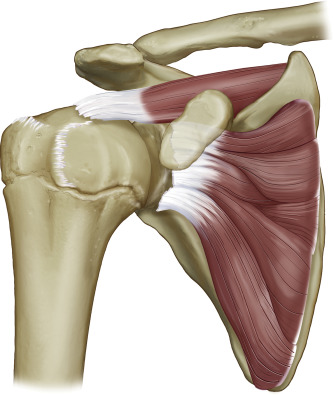
A rotator cuff tear does not always remain a small tear. Over time, a torn tendon may progressively retract away from the bone, while the corresponding muscle becomes smaller and develops fatty degeneration.
When two or more rotator cuff tendons are extensively involved, the injury may be described as a massive rotator cuff tear.
However, massive does not necessarily mean irreparable.
Some very large tears can still be mobilised and repaired arthroscopically. Others have retracted so far, or the muscle and tendon quality has deteriorated so much, that bringing the tendon back to its original attachment without excessive tension is no longer possible.
This is called a massive irreparable rotator cuff tear.
[Learn more about Rotator Cuff Tears →]
Why Does a Rotator Cuff Tear Become Irreparable?
Several changes occur when a large tear remains untreated for a long time:
- The tendon retracts away from the bone
- The tendon becomes shortened and less elastic
- The muscle progressively atrophies
- Fat gradually replaces some of the muscle
- The humeral head may migrate upwards
- Arthritis can eventually develop in the shoulder
This is one reason why a symptomatic large rotator cuff tear should be properly evaluated rather than repeatedly treating the pain alone.
How Do We Decide Whether the Tendon Can Be Repaired?
An MRI provides important information about:
- Size of the tear
- Number of tendons involved
- Amount of tendon retraction
- Muscle atrophy
- Fatty degeneration
- Condition of the subscapularis
- Quality of the remaining tendon
X-rays help determine whether the humeral head has migrated upwards and whether cuff-tear arthropathy has developed.
However, MRI alone does not always determine reparability. In some patients, the final decision can only be made during arthroscopy after the tendon has been carefully released and mobilised.
If Possible, Repair the Patient’s Own Rotator Cuff
Whenever a good-quality tendon can be mobilised back to the bone without excessive tension, an anatomical rotator cuff repair is generally preferred.
Depending on tendon quality, the repair may sometimes be supplemented with biological augmentation.
[Read about Rotator Cuff Repair →]
[Read about Regeneten Bioinductive Augmentation →]
Complications of Massive, Retracted Rotator Cuff Tears
Massive rotator cuff tears may be associated with:
- Fatty infiltration of muscle (accumulation of fats) causing loss of elasticity
- Humeral head subluxation (partial dislocation)
- Impingement of tissues
- Formation of bone spurs
- Osteoarthritis
Diagnosis of Massive, Retracted Rotator Cuff Tears
Your doctor will review your medical history and perform a physical examination to assess pain, movement, and strength. An MRI scan may be ordered to visualize the rotator cuff injury. X-rays may be performed to look at associated bone injuries or defects.
Treatment of Massive, Retracted Rotator Cuff Tears
Surgery is necessary to treat the most massive, retracted rotator cuff tears. Without treatment, shoulder movement becomes abnormal and structures within the shoulder can undergo further damage. Non-surgical treatment may be recommended for elderly patients with limited functional goals.
Surgical goals can often be achieved by arthroscopic surgery. The procedure is performed with the help of a pencil-sized instrument called an arthroscope that contains a miniature camera which relays images to a monitor. The Arthroscopic repair for massive tears usually involves:
- Extensive debridement of tissue fragments at the detached edge of the rotator cuff.
- Mobilization to bring the detached muscle to its original attachment on the humerus.
- Reconstruction of the tendons with a suitable graft may be necessary.
- Attachment of the tendon to bone with the help of suture anchors.
Treatment of Massive Retracted Irreparable Rotator cuff tears

A rotator cuff tear is called Irreparable when most of the muscle belly is infiltrated with fat. This is graded by Goutallier grading. The grades above the (c) in picture is called irreparable, because the muscle mass is too less to allow movements of the shoulder even if repaired by arthroscopic releases.
In such scenarios we resort to Tendon transfers or Superior capsular reconstruction or a Reverse shoulder replacement depending on multiple factors including age, functional requirements etc
What If the Entire Tear Cannot Be Repaired?
Even when complete anatomical repair is impossible, repairing the portions that can be restored may improve the balance of the shoulder.
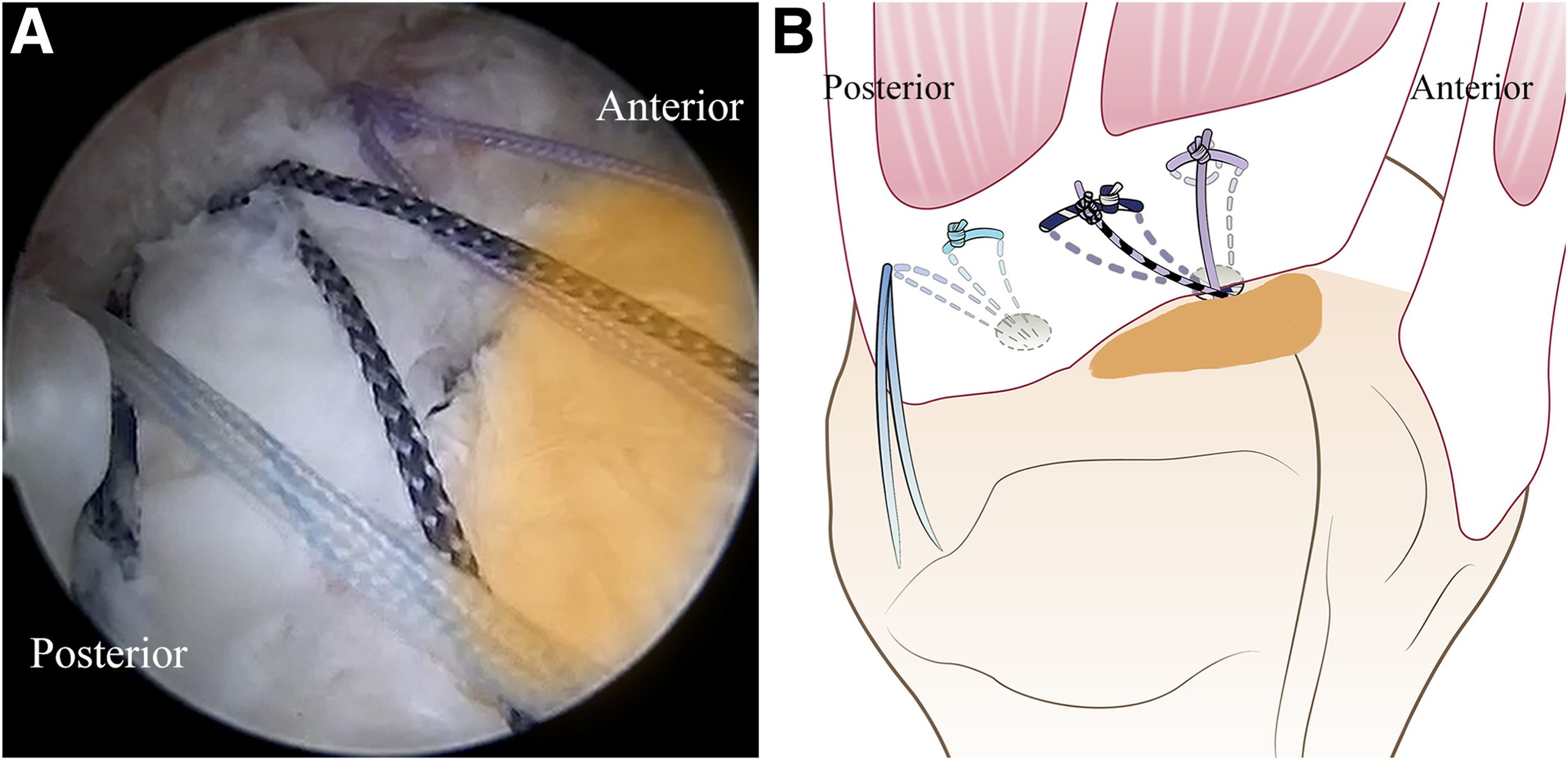
This is called a partial rotator cuff repair.
The objective is not necessarily to close every part of the defect, but to restore the important force couples that help centre the humeral head and allow the deltoid and remaining rotator cuff to work more efficiently.
In selected patients, this can substantially improve pain and function while preserving the natural shoulder.
Superior Capsular Reconstruction (SCR)
In a younger or active patient with an irreparable posterosuperior rotator cuff tear but a relatively preserved shoulder joint, Superior Capsular Reconstruction (SCR) is an important joint-preserving option.
The superior capsule normally helps prevent the humeral head from migrating upwards when the arm is elevated.
When a massive rotator cuff tear destroys this restraint, the humeral head can migrate superiorly and the normal mechanics of the shoulder become inefficient.
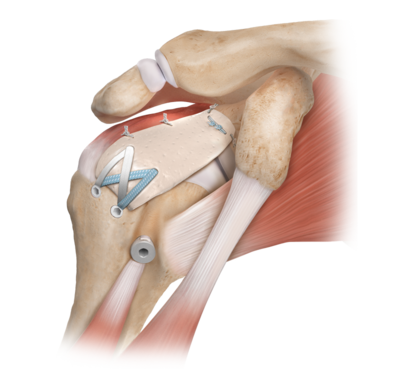
How Does SCR Work?
During arthroscopic SCR, a graft is fixed:
From the upper part of the glenoid → across the top of the humeral head → to the greater tuberosity of the humerus.
The graft does not simply replace the missing rotator cuff muscle.
Instead, it reconstructs the superior capsule, helping:
- Prevent excessive upward migration of the humeral head
- Restore more normal shoulder mechanics
- Improve the efficiency of the remaining rotator cuff and deltoid
- Reduce pain
- Preserve the patient’s natural shoulder joint
SCR is particularly attractive in appropriately selected younger patients without advanced shoulder arthritis.
Patches for Superior Capsular Reconstruction
One option for SCR is a human dermal allograft, such as ArthroFLEX®.
ArthroFLEX is processed donor dermal tissue from which cellular components are removed, leaving a collagen-rich extracellular matrix.
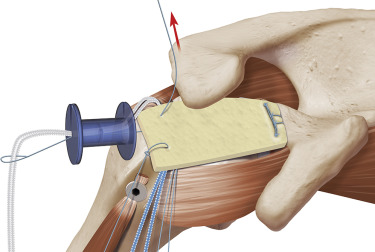
For superior capsular reconstruction, the graft is secured arthroscopically between the superior glenoid and greater tuberosity, creating a new superior restraint over the humeral head.
Potential Advantages
- Avoids harvesting a large graft from the patient’s thigh
- No additional donor-site morbidity
- Provides a substantial biological scaffold
- Allows a completely arthroscopic reconstruction
- Preserves the native shoulder joint
Other grafts, including fascia lata autograft and other allograft tissues, can also be used for SCR.
SCR is a technically demanding procedure and patient selection is extremely important. It is generally more suitable when there is minimal glenohumeral arthritis and the remaining shoulder musculature can still provide useful function.
Tendon Transfers
Sometimes the major problem is not simply pain but the loss of a particular shoulder movement, especially external rotation.
In a young, active patient with an irreparable posterosuperior cuff tear and a preserved shoulder joint, another option is to transfer a functioning tendon from elsewhere around the shoulder.
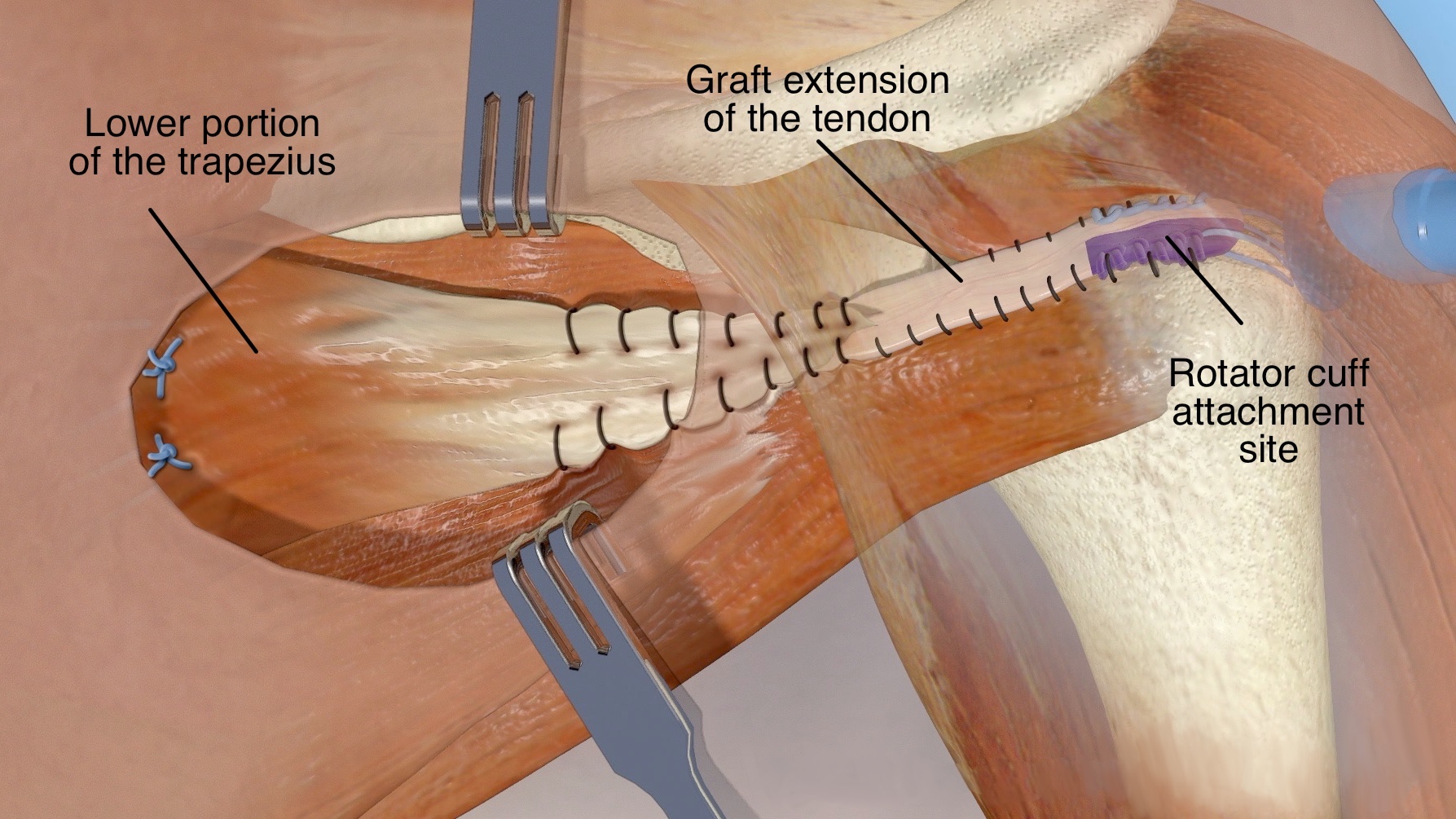
The transferred muscle is redirected so that it can perform some of the function previously provided by the torn rotator cuff.
Lower Trapezius Tendon Transfer
The lower trapezius can be transferred, usually with a graft extension, to help restore external rotation.
Its direction of pull resembles that of the normal posterior rotator cuff, making it an attractive option for selected young and active patients with loss of external rotation.
Latissimus Dorsi Tendon Transfer
The latissimus dorsi has historically been used for irreparable posterosuperior cuff tears.
It can improve external rotation and shoulder function in carefully selected patients.
Who Is a Candidate for Tendon Transfer?
Tendon transfer is generally considered for:
- Younger, active patients
- Irreparable posterosuperior tears
- Significant external rotation weakness
- Minimal glenohumeral arthritis
- A functioning deltoid
- Appropriate remaining rotator cuff function
Tendon transfers are specialised procedures and are not suitable for every massive cuff tear.
InSpace™ Subacromial Balloon Spacer
Another joint-preserving option is the InSpace balloon.
This is a biodegradable balloon inserted arthroscopically into the space between the humeral head and the acromion.
The balloon acts as a temporary spacer.
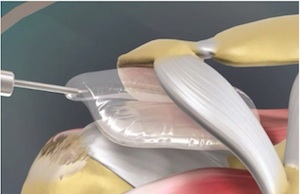
How Does It Work?
By occupying the subacromial space, the balloon can:
- Reduce upward migration of the humeral head
- Improve shoulder biomechanics
- Reduce painful contact
- Allow the deltoid and remaining rotator cuff to function more efficiently
The balloon gradually biodegrades after implantation.
Advantages
- Minimally invasive
- Shorter surgical procedure
- No tendon or graft harvesting
- Can provide pain relief and functional improvement in appropriately selected patients
Limitations
The balloon does not repair or regenerate the missing rotator cuff tendon.
Results depend greatly on patient selection, and the long-term evidence is less predictable than for some established reconstructive procedures.
It is therefore best regarded as a useful option for a specific group of patients rather than a replacement for rotator cuff repair, SCR or reverse shoulder replacement.
When Is Reverse Shoulder Arthroplasty the Better Option?
In an older patient, particularly when a massive irreparable tear is associated with:
- Severe loss of elevation or pseudoparalysis
- Superior migration of the humeral head
- Cuff-tear arthropathy
- Glenohumeral arthritis
- Poor remaining tendon and muscle quality
- Failed previous cuff reconstruction
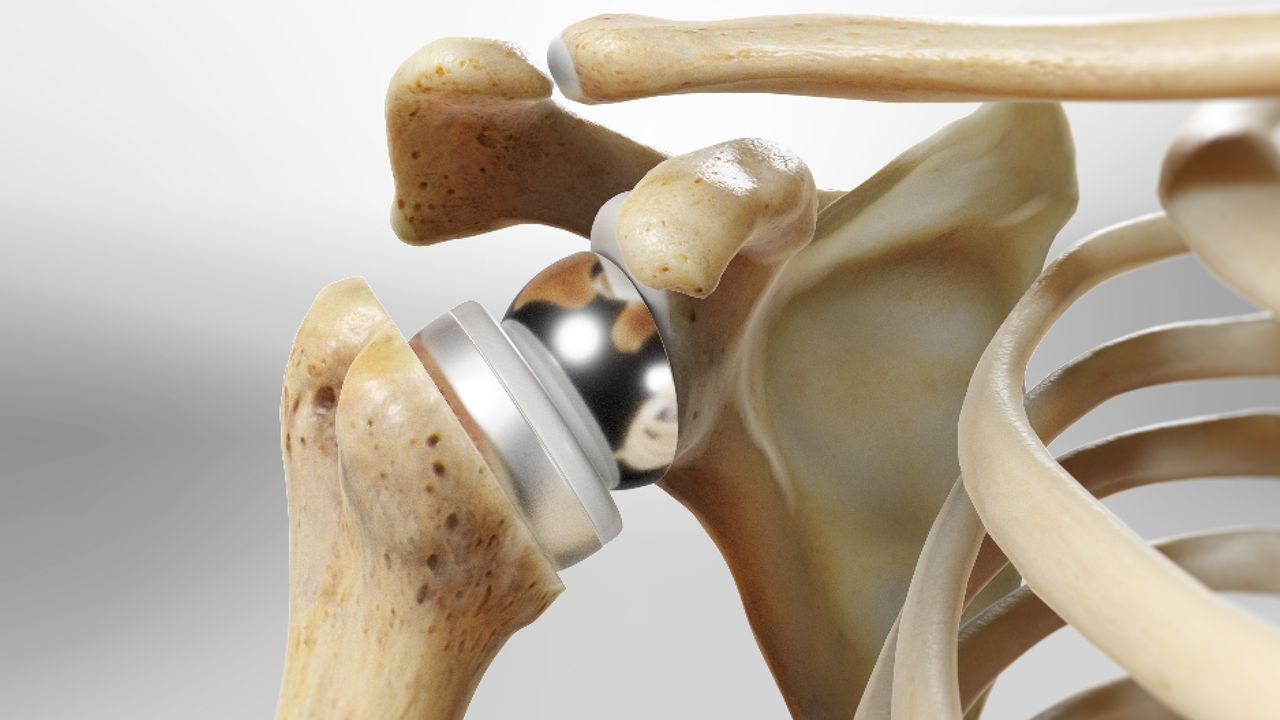
attempting complex tendon reconstruction may not provide predictable function.
In these patients, Reverse Shoulder Arthroplasty (RSA) can provide reliable pain relief and restoration of useful shoulder elevation.
How Does a Reverse Shoulder Work?
A normal shoulder depends heavily on the rotator cuff to centre the humeral head and allow the deltoid to elevate the arm.
A reverse shoulder replacement changes the geometry of the joint so that the deltoid muscle can elevate the arm even when the rotator cuff is no longer functional.
This makes reverse shoulder arthroplasty one of the most reliable treatments for an elderly patient with a massive irreparable cuff tear and loss of shoulder function.
[Learn more about Reverse Shoulder Arthroplasty →]
Treatment According to Age – A Practical Guide
Age alone should never determine treatment. A healthy 70-year-old who plays sport may have very different requirements from a sedentary 60-year-old.
However, age combined with biological condition of the shoulder provides a useful framework.
| Patient Profile | Options Commonly Considered |
|---|---|
| Young patient – approximately <50 years | Attempt anatomical/partial repair whenever possible; SCR or tendon transfer if irreparable; joint preservation strongly preferred |
| 50–65 years, active patient | Repair if possible; augmentation, partial repair, SCR or tendon transfer depending on tear pattern and function |
| Approximately 65–70 years | Highly individualized; repair/SCR in biologically young active patients; balloon spacer or RSA in appropriately selected patients |
| >70 years with preserved joint and reasonable function | Conservative treatment, selective repair/partial repair or other less invasive options depending on symptoms |
| Older patient with pseudoparalysis or cuff-tear arthropathy | Reverse shoulder arthroplasty often provides the most predictable solution |
These are guidelines rather than strict age limits.
We treat the shoulder—not simply the patient’s date of birth.
Activity level, arthritis, muscle quality, remaining rotator cuff function and the patient’s expectations are often more important than chronological age.
A Simple Treatment Philosophy
Step 1 – Can the rotator cuff be repaired?
Yes → Repair the patient’s own tendon whenever appropriate.
Step 2 – Can part of the cuff be restored?
Yes → Consider partial repair ± augmentation.
Step 3 – Young/active patient + irreparable tear + minimal arthritis?
Consider a joint-preserving reconstruction:
- Superior Capsular Reconstruction
- Tendon transfer
- Selected graft/interposition procedures
Step 4 – Selected older patient with an irreparable tear?
A subacromial balloon spacer may be considered in appropriate circumstances.
Step 5 – Irreparable cuff + pseudoparalysis/arthritis in an older patient?
Reverse Shoulder Arthroplasty may provide the most reliable restoration of pain-free function.
Frequently Asked Questions
Does a massive rotator cuff tear always require shoulder replacement?
No.
Many massive tears can still be repaired. Even when the tear is irreparable, younger patients may have joint-preserving options such as SCR or tendon transfer.
What does “retracted rotator cuff tear” mean?
After the tendon tears from the bone, the muscle continues pulling on it. Over time, the tendon may retract progressively away from its original attachment.
The longer a major tear remains retracted, the greater the possibility of muscle atrophy and fatty degeneration.
Can an old rotator cuff tear still be repaired?
Sometimes.
The age of the tear is only one factor. Tendon mobility, retraction, muscle quality, fatty degeneration and arthritis are all important.
An experienced shoulder surgeon can often determine the likelihood of repair from clinical examination and MRI, although the final assessment may occasionally be made during arthroscopy.
What is the difference between SCR and rotator cuff repair?
A rotator cuff repair reconnects the patient’s own torn tendon to the bone.
SCR does not recreate the missing rotator cuff muscle. Instead, it reconstructs the superior capsule to stabilise the humeral head and improve the mechanics of the remaining muscles.
Is ArthroFLEX an artificial patch?
No.
ArthroFLEX is a decellularized human dermal allograft. It provides a collagen matrix that can be used as the graft for superior capsular reconstruction.
Will an InSpace balloon repair my rotator cuff?
No.
The balloon does not repair the torn tendon. It temporarily changes the mechanics of the shoulder and may improve pain and function in appropriately selected patients.
What is pseudoparalysis?
Pseudoparalysis occurs when a patient has great difficulty actively raising the arm because of a massive rotator cuff tear, even though the arm can often be moved through a much greater range when someone else lifts it.
This indicates major disruption of normal shoulder mechanics.
Why not perform reverse shoulder replacement in every irreparable tear?
Reverse shoulder arthroplasty is an excellent operation when appropriately indicated, but it replaces the natural joint with an implant.
In younger patients, implant longevity and potential future revision surgery are important considerations. Therefore, when the joint is healthy and circumstances are favourable, we may first consider procedures that preserve the patient’s natural shoulder.
Can SCR prevent me from ever needing a reverse shoulder replacement?
Not necessarily.
The objective of SCR is to improve function and preserve the natural joint. Some patients may eventually develop progression of cuff disease or arthritis and require further surgery.
Successful joint-preserving surgery, however, may potentially postpone the need for arthroplasty in appropriately selected patients.
Our Approach at DocJoints
A massive rotator cuff tear is not one single disease with one standard operation.
The first objective is to determine whether the patient’s own tendon can still be repaired. When this is not possible, we evaluate the patient’s age, activity level, remaining tendon function, degree of muscle degeneration, arthritis and expectations before recommending treatment.
For younger patients, every reasonable effort is made to preserve the natural shoulder, using techniques such as partial repair, Superior Capsular Reconstruction or tendon transfer when appropriate.
For selected patients, less invasive procedures such as the InSpace balloon may have a role.
For older patients with an irreparable cuff, major loss of function and particularly cuff-tear arthropathy, Reverse Shoulder Arthroplasty provides a powerful and predictable solution.
The goal is not simply to treat an MRI scan—it is to choose the procedure that gives each patient the best balance of pain relief, function, durability and preservation of the shoulder.
Arthroscopic Latarjet changes life of Violinist

Recent Posts

Sr. Consultant Orthopedic Surgeon, Prof & Head,
Institute of Advanced Orthopedics, MOSC Medical College Hospital, Kolenchery, Kochi, Kerala, India - 682311


