
 Call us:+91-484 2885910 (Reception Orthopedics; 9am to 5pm Mon-Sat), +91-484-2885621 (22,23,24)
Doctor's mobile - +91 9497559755 (whatsApp anytime)
Call us:+91-484 2885910 (Reception Orthopedics; 9am to 5pm Mon-Sat), +91-484-2885621 (22,23,24)
Doctor's mobile - +91 9497559755 (whatsApp anytime)
Understanding Pain in the Front of the Shoulder
Pain in the front of the shoulder is one of the most common reasons for consulting a shoulder specialist. While many people believe this is caused by “wear and tear” or a sudden injury, it is often the result of an imbalance in the muscles that stabilize the shoulder joint.
The good news is that most patients improve with the correct rehabilitation programme, avoiding unnecessary surgery.

Why Does the Front of the Shoulder Hurt?
The shoulder is the most mobile joint in the body. Unlike the hip, it has a shallow socket and depends heavily on the surrounding muscles for stability.
The rotator cuff consists of four muscles:
- Supraspinatus
- Infraspinatus
- Subscapularis
- Teres minor
Together, these muscles work as a balanced force couple, keeping the ball of the shoulder (humeral head) perfectly centred within the socket while the larger muscles move the arm.
When this delicate balance is disturbed, the humeral head can move slightly upwards towards the acromion. This places excessive stress on:
- The supraspinatus tendon
- The long head of the biceps tendon
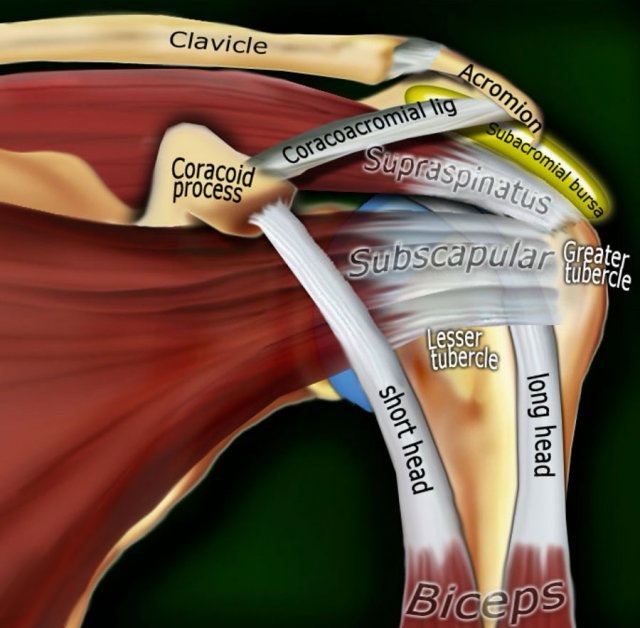
The result is inflammation and pain, commonly referred to as supraspinatus tendinitis or biceps tendinitis.
Why Is It Usually Not a Mechanical Injury?
In many patients, there has been no fall or major trauma.
Instead, the pain develops gradually because the stabilizing muscles become weak or poorly coordinated.
Common contributing factors include:
- Repetitive overhead work
- Poor posture
- Sedentary lifestyle
- Improper gym training
- Muscle imbalance
- Age-related tendon changes
Rather than being “torn,” the tendon is often overloaded because it is working harder than it should.
Typical Symptoms
Patients commonly experience:
- Pain in the front of the shoulder
- Pain over the upper arm
- Pain while reaching overhead
- Difficulty putting on a shirt or bra
- Pain while fastening a seat belt
- Discomfort at night, especially when lying on the affected side
- Weakness during lifting
Why Weight Training Can Make It Worse
Many people begin strengthening exercises using:
- Dumbbells
- Shoulder press
- Bench press
- Lateral raises
- Heavy gym equipment
Unfortunately, these exercises primarily strengthen the large outer muscles, including:
- Deltoid
- Pectoralis major
- Latissimus dorsi
- Upper trapezius
If these muscles become stronger before the rotator cuff has recovered, they pull the shoulder upwards with greater force, increasing tendon irritation.
This is one of the common reasons why shoulder pain persists despite regular gym workouts.
The Correct Treatment: Restore the Force Couples
The primary goal is not simply to strengthen the shoulder—but to restore balance.
The first muscles that need attention are:
- Supraspinatus
- Infraspinatus
- Subscapularis
These are strengthened using:
- Resistance bands (Therabands)
- Cable pulley exercises
- Low-resistance controlled movements
- Exercises performed below shoulder level initially
Only after the rotator cuff has regained sufficient strength should strengthening progress to:
- Deltoid
- Pectoralis muscles
- Latissimus dorsi
- Trapezius
This sequence restores the normal biomechanics of the shoulder and prevents further tendon overload.
Medications
During the painful phase, your doctor may recommend:
- Anti-inflammatory medications
- Pain-relieving medicines
- Ice application
- Temporary modification of activities
These treatments reduce pain but do not correct the underlying muscle imbalance. Rehabilitation remains the cornerstone of recovery.
When Are Injections Helpful?
If symptoms persist despite a well-supervised rehabilitation programme, ultrasound-guided injections may be recommended.
These may include:
- Platelet-Rich Plasma (PRP)
- Growth factor-based injections
- Other biologic treatments, depending on the clinical situation
Ultrasound guidance ensures accurate placement around the affected tendon while avoiding important nearby structures.
These injections are intended to support healing and should be combined with a structured strengthening programme rather than replacing it.
When Is an MRI Needed?
If pain continues for more than six weeks, despite appropriate rehabilitation and medication, further evaluation is advisable.
A 3 Tesla MRI scan provides excellent detail of the rotator cuff tendons and surrounding structures.
An MRI helps identify:
- Tendinitis
- Partial-thickness tears
- Full-thickness tears
- Biceps tendon pathology
- SLAP (Superior Labrum Anterior to Posterior) lesions
- Bursitis
- Muscle quality and tendon retraction
When Is Surgery Necessary?
Most patients do not require surgery.
However, arthroscopic surgery may be considered if imaging shows:
- A tear involving more than 50% of the supraspinatus tendon footprint
- Persistent symptoms despite adequate conservative treatment
- A significant SLAP lesion affecting the attachment of the long head of the biceps
- Mechanical symptoms such as catching or locking associated with structural damage
Modern arthroscopic surgery allows these conditions to be treated through small incisions with faster rehabilitation compared to traditional open surgery.
Frequently Asked Questions
Does shoulder pain always mean a tendon tear?
No. Most patients have inflammation or tendon overload rather than a significant tear.
Can I continue going to the gym?
Yes—but your programme should focus initially on rotator cuff rehabilitation rather than heavy shoulder strengthening.
Should I stop all exercises?
No. Appropriate exercises are actually the most important part of treatment. The key is performing the right exercises in the correct sequence.
How long does recovery take?
Most patients begin improving within 6–12 weeks of a properly supervised rehabilitation programme, although tendon remodelling continues for several months.
Is an injection better than exercise?
No. Injections may reduce pain or stimulate healing, but they cannot restore the normal balance of the shoulder muscles. A structured rehabilitation programme remains essential.
Key Take-Home Messages
- Front-of-shoulder pain is commonly caused by supraspinatus and biceps tendinitis, resulting from an imbalance of the shoulder’s force couples rather than a major injury.
- The first step in treatment is to restore the strength and coordination of the rotator cuff—particularly the supraspinatus, infraspinatus, and subscapularis.
- Heavy weight training of the deltoid, pectorals, latissimus dorsi, and trapezius should be delayed until the rotator cuff has regained adequate strength, as premature strengthening can worsen symptoms.
- If symptoms persist beyond six weeks, a 3 Tesla MRI can help identify partial tears, biceps pathology, or SLAP lesions.
- Surgery is reserved for carefully selected patients with significant structural damage or those who do not improve despite appropriate conservative treatment.
DocJoints Expert Tip
“The shoulder functions like a well-rehearsed orchestra. The rotator cuff is the conductor that keeps every movement in harmony. Strengthening the larger muscles before restoring the rotator cuff is like turning up the volume of the instruments while the conductor is absent—it creates imbalance, overload, and pain. Treat the cause, not just the symptoms.”
Arthroscopic Latarjet changes life of Violinist

Recent Posts

Sr. Consultant Orthopedic Surgeon, Prof & Head,
Institute of Advanced Orthopedics, MOSC Medical College Hospital, Kolenchery, Kochi, Kerala, India - 682311


